The real life story of the Universe
Foreword
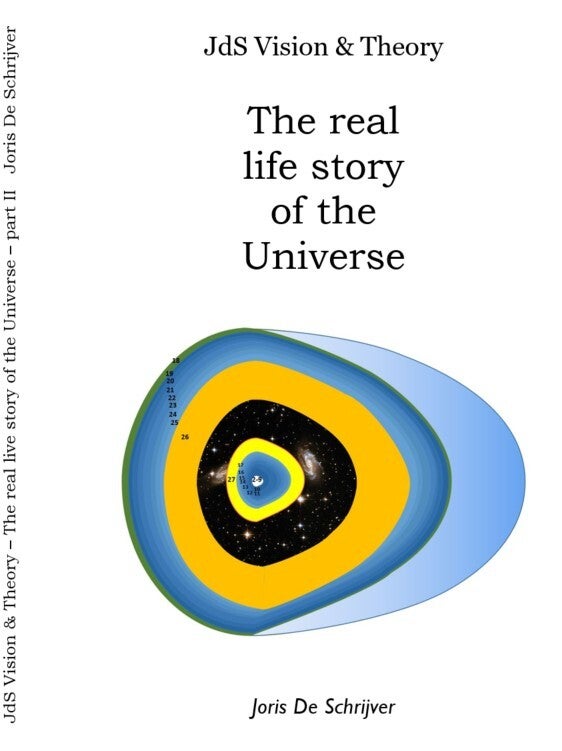
The story I wish to share with you is my perspective on the life cycle of the Universe, how the entire Universe and the Cosmos emerge from a single seed. I invite you on a journey that begins before the well-known moment of the “Big Bang.” It is a journey through various places and dimensions, each with its own story to tell—a narrative that will not only provide insight into the structure of the Universe and the Cosmos, but also reveal how they were built, step by step. To grasp how this story unfolds, we can observe nature itself; it offers us clues and fresh insights on many levels, allowing us to draw analogies between similar phenomena, processes, or events. We can use such an analogy to deduce the nature and structure of the Universe and the Cosmos. The analogy I employ here is the human being. If we examine how a human develops—from conception to infancy, and eventually to adulthood—we can identify seven distinct phases in the life story following birth. We know that a human being originates from a single fertilized egg, growing into a baby within the womb before being born after 42 weeks. Once born, we pass through an initial period as an infant, which we shall call the “1st phase.” This is followed by the years of early childhood—the “2nd phase”—leading toward adolescence or young adulthood, which we can designate as the “3rd phase.” We reach our peak as adults during the “4th phase,” after which we transition into a “5th phase” characterized by advancing age—a time when we begin to shrink, leading up to retirement. This brings us to our “6th phase” as retirees. A period of relaxation and enjoyment follows a long career of work. Subsequently, a final “7th phase” of decline occurs, leading to physical death and, with it, the attainment of spiritual rest. In this way, we can analogously divide the story of the Universe into seven phases. This includes various preliminary stages—from growth to the state of an infant Universe within the womb—culminating in the Big Bang. Following this birth, the Big Bang phase serves as the “1st phase,” lasting 5,000 billion years, succeeded by a “2nd phase” (the toddler/creative phase) of 1,348 billion years. The “3rd phase” (up to adolescence or young adulthood) spans 50,782 billion years. The “4th phase” (adulthood, or the second stage of existence) lasts 98,390 billion years, as does the “5th phase” (advanced age). The “6th phase” (retirement) lasts 50,782 billion years. The final “7th phase” (decline) is a period of transformation and contraction, lasting 6,348 billion years. This results in a total lifespan for the Universe of 311,039.99 billion years—or what I term “1 GREAT TIME.” As previously outlined in my first book (*JdS Theory: The Cosmic Egg and the 280 Particles of the Universe*), we begin with a single, multidimensional, pure energy, which serves as the foundation from which the entire Universe—including our material cosmos—is constructed. In this first book, the focus was on describing and unraveling the 280 particles that constitute two major foundational blocks in the structure of the Universe. We attempted to frame this within a broader system of seven primary blocks, which we will now revisit and examine in greater detail. To gain a better understanding of which particles play a role in this structure—and how they combine to form matter—it is highly recommended to read my “first book – JdS Theory” beforehand. The focus here is on describing the previously unaddressed foundational blocks—covering both the initial stages of the Universe’s emergence and providing a comprehensive overview from beginning to end, including all significant intermediate steps and elements. Not every block will be discussed with the same level of detail; rather, by learning and explaining things step by step, we follow the natural path of evolution. A precise understanding of each stage becomes increasingly important as we progress, ensuring that the logic of the narrative remains clear. The goal of this account is to reveal the underlying thread—the process by which everything is constructed and realized, step by step—viewed through the lens of how the Universe’s initial energy develops across its seven primary structural layers. This approach integrates multiple perspectives: examining the energetic composition, the state of aggregation, and the original makeup of the multidimensional, pure, primordial energy. In this process, we will also see that ending, destruction, or death should not necessarily be viewed as negative; rather, they represent a transition from one state to another. I hope that everyone will be inspired to use my vision regarding the origin of the Universe to conduct further research aimed at gaining a deeper understanding, comprehension, and explanation.