Blog - JdS-vision - The Cosmos
In this blog, we explore the universe—a subject examined in great detail throughout my books.
Each book has its own specific focus, designed to immerse the reader in a fresh perspective on the universe, revealing its inherent beauty and unique interconnectedness. Discover what makes my books so special and what you can expect when you read them. For together, they form a trilogy.


My first book presentation
Sunday, April 13, 2025: my first book presentation.
Now that my third book is complete, it is time to bring my trilogy into the spotlight.
The Third Quantum Revolution
“After 100 years, the JdS vision & theory offers a new perspective.”
1925 marked the beginning of the first quantum revolution. Much has happened since then, and *EOS Wetenschap* (a science magazine) speaks of an ongoing second revolution.
In 2025—the Year of Quantum Science—Joris De Schrijver aims to bring his vision to light.
A century later, we remain stuck at the third layer of quarks. Dark forces and energies are hypothesized, yet they have not yet been mapped.
In his first book "The 280 Particles of the Universe" he describes how starting with the force of gravity, 14 distinct layers can be identified within the complete structure leading up to an atom.
Could his vision help scientists further unravel the mysteries?
Following his first book, he went on to write a second: "The True Life Story of the Universe."
In it, he recounts the entire history of the Universe, from its origins before the Big Bang, through its continued existence, all the way to the end of our observable Universe, 311,040 billion years hence.
This year, he releases his third book, completing the trilogy and covering all aspects of the Universe.
The focus here shifts to humanity. The title "The Link Between Mind, Consciousness, and the Brain" makes the subject matter immediately clear.
A fresh, new perspective on life that provides answers to many fundamental existential questions.
The atom structure throughout the years
De insights in to the atom structure
1. Thomson (1897)
The atom model of Thomson, with electrons in a positive charged orb.

2. Ruthersforth (1911)
The schematic representation of an atom according to the theorie of Ruthersford:

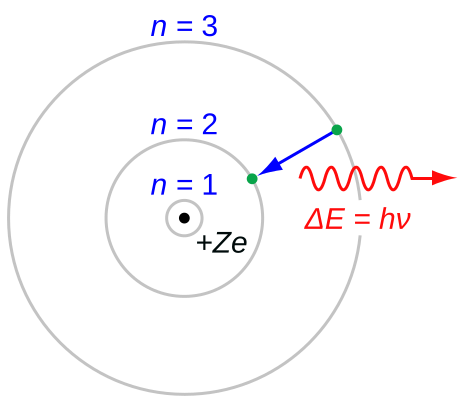
3. Bohr's model (1913)
The different layers of electrons orbits in the Bohr-model:
4. The Louis de Broglie (1924) particles as wave principle
The principle of wave-particle duality, introduced by Louis de Broglie in 1924, states that every moving particle (such as an electron) also possesses a wave-like character. A classic way to represent this concept schematically is through a "wave packet"—a localized wave that represents the probability of the particle's position.
https://nl.wikipedia.org/wiki/Hypothese_van_De_Broglie
5. The Werner Heisenberg’s (1925) formulation of quantum mechanics.
In 1925, Werner Heisenberg introduced matrix mechanics, the very first complete mathematical formulation of quantum mechanics. Instead of attempting to map the invisible paths of electrons (as in the older Bohr model of the atom), Heisenberg focused exclusively on measurable quantities, such as the frequency and intensity of emitted light (spectral lines).
https://nl.wikipedia.org/wiki/Onzekerheidsrelatie_van_Heisenberg
6. Erwin Schrödinger (1926) and the Schrödinger equation: a description of electrons as three-dimensional waves.
https://nl.wikipedia.org/wiki/Erwin_Schr%C3%B6dinger
7. De interne Kern-voorstelling volgens de JdS-Visie & theorie
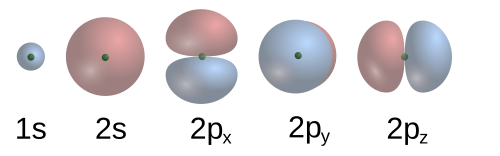
As a result of this internal structure of protons and neutrons, electrons occupy various orbitals.
Protons and neutrons form a specific structure, rather than just a random sphere. Furthermore, the number of protons and neutrons is equal, contrary to the current prevailing view that extra neutrons account for the additional mass. As the extra mass is actually a result of an increase mass of the electrons.

The Carbon-atom
The internal structure will ensure that the bonding of the electrons is focused on the vertices of a tetrahedron.

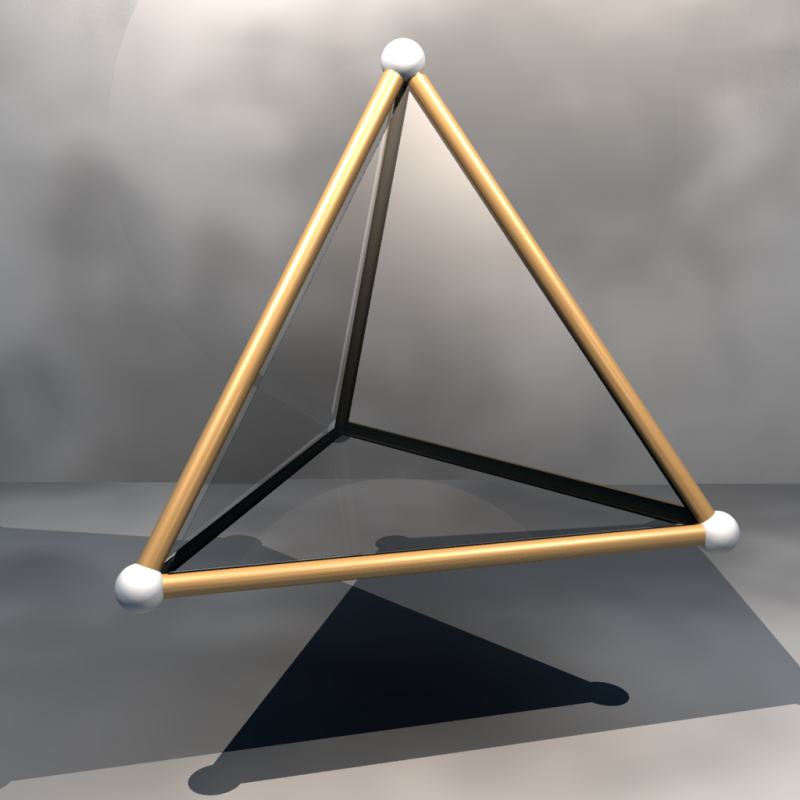
On the left is the tetrahedron formed by the bonding of the electrons. They will be most concentrated in that specific location.
UPDATE 2025-10: Searching for a New Force
Link to webpage : Fifth force
A hypothetical fifth force could be detected by its effect on the optical transition frequencies of an element’s different isotopes.
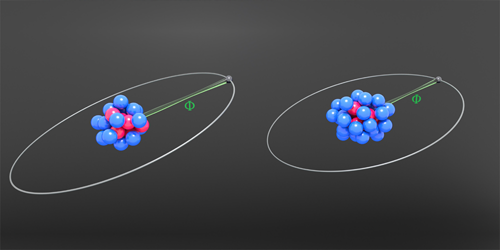
A. Wilzewski et al., “Nonlinear calcium King plot constrains new bosons and nuclear properties,” Phys. Rev. Lett. 134, 233002 (2025).
Read our latest news
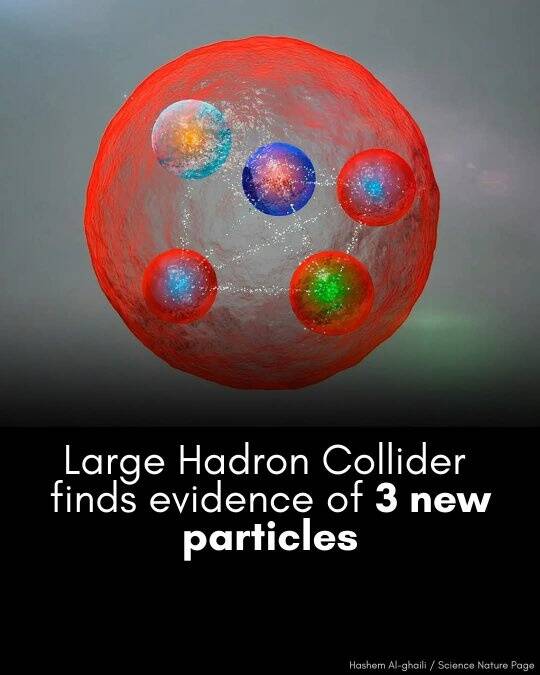
Since 2022, researchers have made a discovery of new particles, which are already explained in my book: https://www.sciencealert.com/large-hadron-collider-finds-three-never-before-seen-exotic-particles .